Aug
2013

Immanuel

For the last few weeks, we have been thinking about the Jesus’ death on the cross, and what his death means for us.  As a young Christian, the only way of understanding the cross I knew was penal substitution: that Jesus had taken on himself God’s wrath, and the deserved punishment for my sin, so that I could be forgiven.  I grew up singing “There Is a Fountain Filled With Blood,” and “Jesus Paid It All.”  However, like many believers, I have come to be dissatisfied with that model.  I am disturbed by what it says about God, that God’s wrath can only be assuaged by blood, even the blood of his innocent Son.   I am concerned that this approach, focused solely on the death of Jesus, seems to make his life and teaching irrelevant.  In my August 6 blog, I wrote:

There are other biblical models for understanding the cross–most powerfully, I propose, the notion of Jesus as Immanuel (God with us) who expresses God’s presence with us even in the midst of pain, abandonment, and death itself.

This week and next, I am going to unpack that statement.  Today, we will pursue the origin and meaning of the name “Immanuel.”  Next week, we will consider how identifying Jesus as God With Us constitutes a way of understanding the atonement.

Matthew 1:18-24 provides the background for a Child ballad (no. 54) still sung in Appalachia, a Christmas carol called “The Cherry Tree.”   This strange little story never makes it into the Christmas pageants–probably because of its mature language and themes!

Mary, Joseph’s fiancee, is pregnant.  Joseph reaches the obvious, natural conclusion: Mary must have been unfaithful to him.  Certainly, the engagement was off, but in that culture, at that time, more could have–indeed many would have thought, should have–happened.  Mary’s actions had brought shame upon Joseph, as well as upon her own family.  At the least, she should have been exposed to public shame.  At the worst, with the evidence of her pregnancy to confirm her faithlessness, Mary could have been stoned to death (Leviticus 20:10; Deuteronomy 22:13-28, especially 20-21 and 23-27). In some parts of the world, such “honor killings” still occur today.


But Joseph wanted nothing to do with any of this:

Joseph her husband was a righteous man. Because he didn’t want to humiliate her, he decided to call off their engagement quietly (Matt 1:19, CEB).

Before Joseph could act on his decision, however, an angel appeared in a dream, to assure him of Mary’s faithfulness.  Her pregnancy was a miracle; her child “was conceived by the Holy Spirit” (Matt 1:20, CEB)!  Further, the angel gave Joseph instructions concerning this child: “you will call him Jesus” (Matt 1:21, CEB).

The name Jesus (Greek Iesous; Aramaic Yeshua) is a form of the name “Joshua,” derived like that name from the Semitic word for “salvation,” yeshuah.  He is to be named this because of his life’s work: “he will save his people from their sins” (Matt 1:21, CEB).

A second name is also given to the child, however–not by Joseph, but by the writer of this gospel, for the eyes and ears of its readers and hearers (Matt 1:22-23, CEB):

Now all of this took place so that what the Lord had spoken through the prophet would be fulfilled:

Look! A virgin will become pregnant and give birth to a son,
        And they will call him, Emmanuel.

(Emmanuel means “God with us.”) 

One characteristic feature of Matthew’s gospel is the quotation of Scriptures that foreshadow Jesus’ life and ministry.  Here, he is quoting from Isaiah 7:10-16.

Before we think about how Matthew reads this passage, we need to see it in its context.  In the middle of the eighth century BC, Jerusalem was under siege: the king of the northern kingdom of Israel, Pekah, and the king of Syria, Rezin, had forged an alliance against the superpower of their day, Assyria.  When Ahaz of Judah refused to join their alliance, they decided to take from him by force the resources he would not yield voluntarily.  Bible scholars call this the Syro-Ephraimite War.

Ahaz is faced with a serious dilemma.  So far as he can see, he has only two choices: he can surrender to the Syro-Ephraimite alliance, or he can surrender to the advancing Assyrian armies.  The prophet Isaiah presents a third option: wait, and trust in God to deliver God’s city.

As we can imagine, the prophet’s option doesn’t hold much attraction for a realistic-minded politician like Ahaz!  So, speaking in the name of the Lord, the prophet makes an offer:

Ask a sign from the Lord your God. Make it as deep as the grave [Hebrew Sheol: the underworld,  or the place of the dead] or as high as heaven (Isa 7:10).

The king responds, with pompous piety: “I won’t ask; I won’t test the Lord” (Isa 7:12; compare Deuteronomy 6:16).  Of course, since it is God who is offering a sign to the king, Ahaz is just blowing smoke.  The exasperated prophet responds:

Isn’t it enough for you to be tiresome for people that you are also tiresome before my God?  Therefore, the Lord will give you a sign. The young woman is pregnant and is about to give birth to a son, and she will name him Immanuel (Isa 7:13-14).

Isaiah does not say to whom this child will be born.  Since elsewhere in Isaiah 7-8, Isaiah gives his own children symbolic names, this may refer to Isaiah’s own child.  Immanuel is mentioned elsewhere in this book, however (see Isa 8:8, NRSV), in a way that sounds as though this is a royal name: perhaps referring to Ahaz’ own son, Hezekiah.

The significance of the sign, however, lies not in who the child is, but in the meaning of his symbolic name, and in the timing of his birth.  In Hebrew, ‘immanu ‘El means “God is with us.”  Ahaz does not need to fear Pekah and Rezin: Judah has a more powerful ally than any earthly army!  The child Immanuel, whose birth is imminent, will by the time that he is weaned (early toddlerhood, when he begins to be able to “reject evil and choose good”) be able to eat “butter and honey” (CEB; perhaps the NRSV “curds and honey” is better): products of the countryside, not available in a city under siege.  In other words, the siege will not last much more than a year or two: “Before the boy learns to reject evil and choose good, the land of the two kings you dread will be abandoned” (Isa 7:16).

To understand Matthew’s use of this passage, we need to remember, first, that Matthew believes that the Scriptures of Israel point toward Christ–how could they not?  Reading the Scriptures through Christian lenses, alert for passages that prefigure Jesus’ coming, Matthew would of course have hit upon this passage in Isaiah.  His own experience of God through Christ had taught him that all that God is was present, powerfully, in the person of Jesus.  Jesus is God–God in our midst, God with us!  Who else could “Immanuel” possibly be?

Second, we need to remember that Matthew was probably reading Isaiah, not in Hebrew, but in the Greek of the Septuagint (see the Bible Guy blog for May 28, 2013).  Isaiah says that “The young woman is pregnant” (Isa 7:14); in Hebrew, the word he uses for “young woman” is ‘almah: a term for a young woman of marriageable age, implying nothing about her virginity or lack thereof.  In the Septuagint, this word is translated by the Greek parthenos.  Probably in the second century BC when that translation was done, parthenos could have the same implications as the Hebrew ‘almah.  But it could also mean–and certainly by Matthew’s time primarily meant–virgin.  For example, the famous temple in Athens to Athena, the virgin goddess, was called the Parthenon.

Matthew’s tradition told him (as Luke’s told him; cf. Luke 1:26-38) that Jesus’ birth was a miracle, as his mother was a virgin.  This detail would, in his mind, have clinched the identification: Jesus was Immanuel!

Later in Matthew’s gospel, these two names–Jesus and Emmanuel–will recur, specifically in connection with Jesus’ passion, resurrection, and ascension.  Between them, they express briefly and powerfully what it means for Matthew to acclaim Jesus as the Christ.

AFTERWORD:
OLYMPUS DIGITAL CAMERA

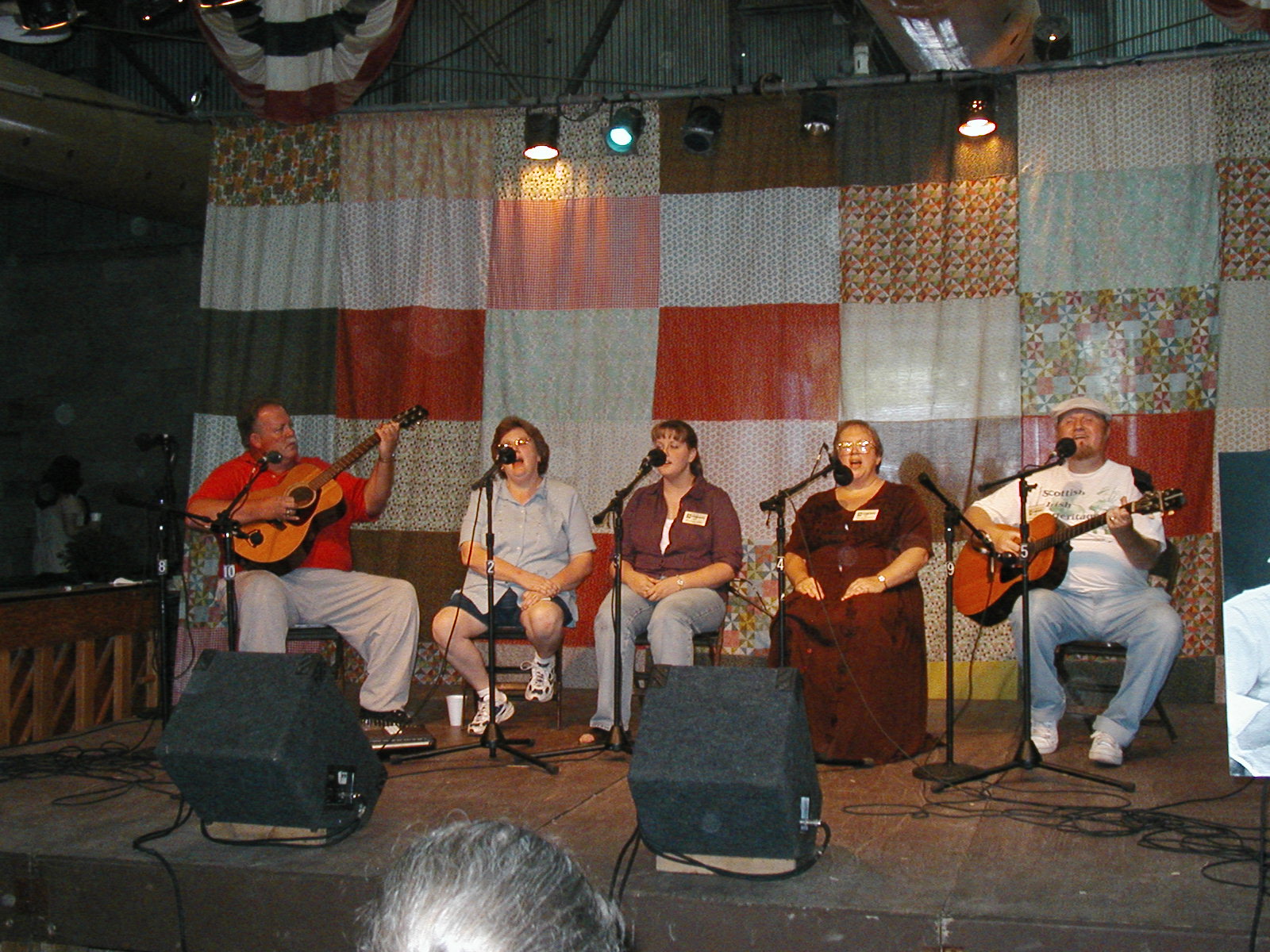
The Bible Guy is off this weekend to The Gathering, a festival of folk, traditional, and old-time music in Mineral Wells, West Virginia, hosted and organized by my brother-in-law Steve Parker and my sister Tammy.  I will be preaching at the worship service on Sunday.  This is always a highlight of my year–I invite you all to come, if you can!

Aug
2013

Atonement

I have heard more responses, both in the form of comments and in the form of Facebook posts and conversation, on my blog from the first week of August, “‘The wrath of God was satisfied’?” than from any other post since I began this blog in February!  For those just joining us, this post dealt in part with the decision not to include “In Christ Alone” in the new PCUSA hymnal, after the authors insisted on keeping the line

Till on that cross as Jesus died,
The wrath of God was satisfied.

In a blog at Patheos’ Evangelical Portal, called “Christianity Without the Atonement” Gene Edward Veith concludes that, for the hymnal committee, “What was objectionable is the doctrine of the atonement.”

I don’t understand Mr. Veith’s conclusion at all.  Indeed, knowing people involved in this decision, and having team-taught a course with one of them (called, ironically, “Models of the Atonement”!), I know that the committee did not object to the Christian doctrine of the atonement.  Mr. Veith rightly asks,

What is the point of Christianity without the atonement?  It becomes turned into another religion.  I suppose the attraction is that it gives us another religion of law, which people somehow prefer to a religion that says they are sinners in need of forgiveness and, yes, atonement.

The question, however, is not, and has never been, whether we believe in the atonement or not.  The cross is not at issue.  The love of Jesus, and his suffering for us; the grace of God; the realization that God’s power, love, and grace are communicated by the cross; the fact that we are sinners who cannot save ourselves–none of this is at issue.  The only question is, what happens on the cross?  What does it mean to say, as Christians have said from the very first, that Jesus died for us?

The verb “atone” and the noun “atonement” are  only about 500 years old.  The Oxford Dictionary dates them to the early 16th century, when they were coined out of  the phrase “at one”–influenced by the Latin word adunamentum (“unity”), and an older word, “onement” (from an obsolete verb form, “to one,” meaning “to unite”).  The word was used particularly in Christian circles to talk about the unification of God and humanity accomplished by Christ.

In particular, “make atonement” was used in the KJV to translate the Hebrew verb kipper, particularly as it is used in Leviticus 16 in connection with Yom Kippur, the Day of Atonement.  While this word apparently had the original meaning “cover,” it came to be used specifically for rites of cleansing and purification.  In ancient Israel, Yom Kippur was the day when all lingering defilement from the previous year, either accidental or deliberate, was expunged, making full access to and communion with God possible in the new year.

The CEB appropriately translates Yom Kippur as “Day of Reconciliation.”  In modern Judaism, Yom Kippur is a day of fasting, self-examination and repentance that concludes the ten Days of Awe with which the Jewish year begins.

The centerpiece of the ancient ritual for this day involved two goats.  One was selected by lot as the goat to be offered as the sin offering (the most familiar translation of the Hebrew khatat; the CEB reads “purification offering,” which better catches the significance of this sacrifice in ancient Israel).  The second goat is Azazel’s.  We have no idea what this means; perhaps Azazel was a monster or demon believed to live in waste places, or perhaps Azazel is an old word for “wilderness.”  The KJV read “scapegoat,” which has entered our language as a person or group who are blamed for wrongs done by others.

In Leviticus, the goat for Azazel is not a sacrifice, nor is it killed.  It is driven out into the wilderness, symbolically carrying away the sins of the people.  The other goat, selected by lot as belonging to the Lord, is sacrificed.  Its blood is taken by the high priest into the inner room of the shrine, called the Most Holy Place, where God was believed to be specially present.

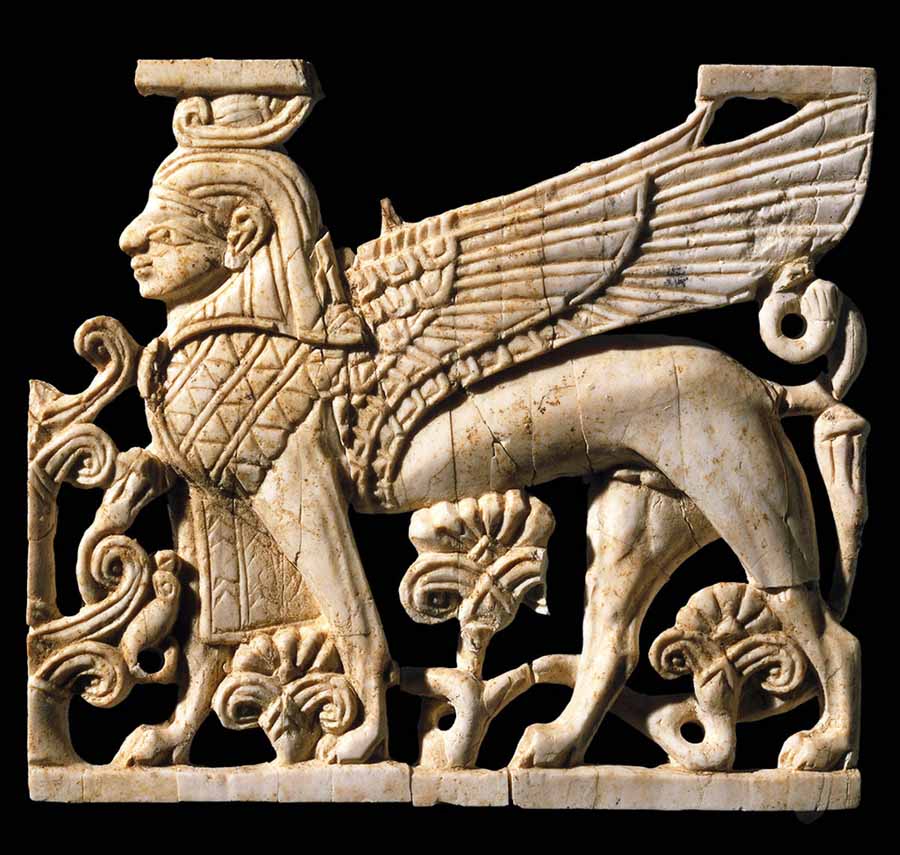
In the shrines of neighboring people, built on a similar plan to Israel’s shrine, this inner room contained the image of the god.  But in Israel’s temple, this inner chamber held not an image, but a golden box, usually called the Ark (though the Hebrew word for the Ark, ‘aron, simply means “box,” or “chest”).  The lid of the Ark was a slab of gold, molded in the image of two cherubim: terrible semi-divine heavenly beings like winged sphinxes.

The cherubim‘s inner wings overlapped to form a seat–a cherub throne, as the divine title “the LORD, who is enthroned on the cherubim” indicates (for example, 1 Sam 4:4; Ps 80:1).  The Ark served as the Lord’s footstool, the place where the divine feet touch the earth.  Hence, the ark was the intersection of divine and human worlds, and the place of the Lord’s special presence.  In the days of Israel’s wilderness wandering, the Ark was where Moses and Aaron encountered the Lord (for example, Exod 25:22).

On Yom Kippur, the blood from the people’s purification offerings was applied to the lid of the Ark (kapporet in Hebrew; sometimes translated as “mercy seat,” but best rendered, as the CEB has it, simply as “cover” or “lid”).  This meant that, once a year, the blood of the purification offering was brought to the very feet of God.

What does this have to do with the cross?  In several places in the New Testament, sacrificial language is used for the cross.  In Romans 3:23-25 (NRSV), Paul writes:

since all have sinned and fall short of the glory of God; they are now justified by his grace as a gift, through the redemption that is in Christ Jesus, whom God put forward as a sacrifice of atonement by his blood, effective through faith.

The Greek word translated “sacrifice of atonement” in the NRSV (the KJV has “propitiation”) is hilasterion.  This same Greek word is used in Leviticus 16, not for the sacrifice, but for the kapporet.  Better, then, is the CEB translation, “place of sacrifice,” though even that may be misleading.  Paul’s point is that the cross is where atonement happens: just as, in the ancient rites on Yom Kippur, the lid of the Ark was the place where the damage done by a year of uncleanness was undone.

Scripture provides numerous models for thinking about what happens on the cross: indeed, in these three short verses, Paul offers two: an economic model (our freedom is purchased, that is, we are redeemed, by Christ’s death), and a ritual model (Jesus as our hilasterion).  The point of his ritual metaphor is that the cross is where the gap between God and humanity is undone.

Later Christian thinkers offered still more models, including John Calvin’s proposal that Jesus took on himself the punishment due us for our sin–a model called “penal substitution.”  This is the model reflected in the statement that God’s wrath was satisfied by Jesus’ death.  Atonement does not mean “penal substitution,” however.  That model has nothing to do with Yom Kippur: Leviticus does not say that the sacrifices take the place of the people who offer them, and neither does Paul.

There is more to say, of course.  My only point, in this blog, is that atonement is a bigger idea than any single model.  We can have questions and reservations about Calvin’s explanation of the atonement without denying the reality of the atonement.  However we wrap our heads around this truth, we can confess unwaveringly what the very earliest church discovered: that in the person of Jesus, and particularly in his suffering and death, the gap between humanity and divinity has been overcome.  Through Jesus, we are made “at one” with God.

Aug
2013

Loving God With All Your Mind

The Gospel account of Jesus’s teaching on the Great Commandment is found in Matthew 22:34-40Mark 12:28-34; and Luke 10:25-28.  These accounts differ on small points: in Matthew, the expert on the Jewish law seeks to test Jesus when he asks his question; in Mark, his question is sincere; in Luke, it is Jesus who questions the expert.  In all three, however, the answer is the same: no single commandment is the greatest.  The Torah hangs not on one, but on two essential prescriptions: love for God, and love for neighbor.

The second “great commandment” is fairly straightforward.  Leviticus 19:18 says, “you must love your neighbor as yourself; I am the Lord.”

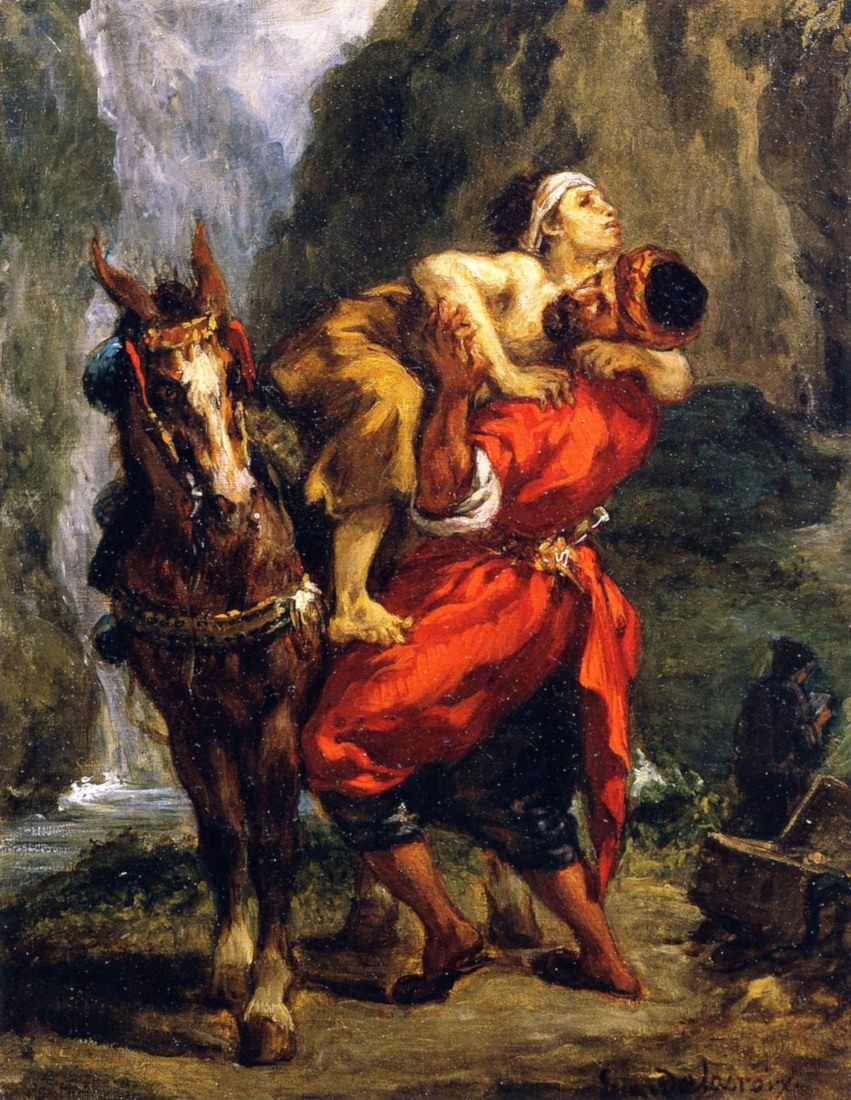
Eugène Delacroix: The Good Samaritan (1849)

One could perhaps ask, as the lawyer does in Luke 10:29, “And who is my neighbor?”  But we know, as he certainly must have known, that this is a worthless question.  The real question, as Jesus’ famous story of the Good Samaritan demonstrates, is how can we demonstrate love for our neighbors?

The commandment to love God comes from Deuteronomy 6:5: “Love the LORD your God with all your heart, all your being, and all your strength.”  While many interpretations of this commandment find here three different ways of loving God, that does not seem to be the intent of the passage in Deuteronomy.  The heart (lebab in Hebrew) is the center of the will: loving God with all your heart means loving God as much as you can.  To love God with all one’s being (Hebrew nephesh should not be translated as “soul;” it refers, as the CEB translation “being” indicates, to the whole of oneself) is another way of saying that one is to love God entirely.  The last word, typically translated “strength” or “might,” is me’od in Hebrew; it means literally “much” or “very.”  We are to love God with our muchness–again, as much as we are possibly capable of loving!

In the Greek of the New Testament, however, and in the minds of early Christians influenced by Greek thought, this command does become a threefold (or more) depiction of loving God with every aspect of one’s being.  The KJV of Mark 12:30 reads,”And thou shalt love the Lord thy God with all thy heart, and with all thy soul, and with all thy mind, and with all thy strength.”  The heart (Greek kardia) is in Greek as in Hebrew the center of the self, or the will–the choosing, deciding aspect of the person.  The soul (Greek psyche) can refer (unlike Hebrew nephesh) to the immaterial, spiritual part of the person.  One’s might (Greek hischus) could be regarded as relating to one’s physical, material self.  Which leaves the Greek word dianoia, referring to thoughts and intentions, commonly translated as “mind.”

St. Anselm Church - Home | Facebook

What might it mean to love God with all one’s mind?  At the opening of his theological treatise ProslogiumSaint Anselm of Canterbury prays,

I do not endeavor, O Lord, to penetrate thy sublimity, for in no wise do I compare my understanding with that; but I long to understand in some degree thy truth, which my heart believes and loves. For I do not seek to understand that I may believe, but I believe in order to understand. For this also I believe,—that unless I believed, I should not understand.

Indeed, Anselm writes, he had at first intended to title this theological work “Faith Seeking Understanding.”

In a comment on last week’s blog (“‘The wrath of God was satisfied’?,” August 6. 2013), one person wrote in part:

This is the main paradox of theology. The attempt to explain something only leads to further confusion. The simplicity of the faith is destroyed by a series of complex negotiations with the truth in order to produce a palatable, watered down version of an AMAZING gift of grace which is freely given (not coerced).  So many want to say what the Gospel isn’t to make it more tolerable so that we can get people to buy in on that soft marginal basis. 

St. Anselm would say amen to part of this.  We come to know and love God first through God’s love and grace showered on us, freely and without regard to our worthiness.  God loves us first.  As a Christian believer, I came to know that love of God through my experience of Jesus’ love and forgiveness.  No one is every argued into the kingdom: all of us are loved in.  The experience of God’s grace through faith in Christ comes first.  When I forget that essential order, I trust that you all will join in reminding me.

But that said, having experienced God, we seek to talk meaningfully and intelligibly about what has happened to us.  Our experience is not rational–that is, it cannot be reduced to reason.  But it is surely not irrational, either.

God created the universe, which though vast and mysterious is yet comprehensible and knowable: so much so that the intelligibility of the universe, which is describable by mathematics, is one strong demonstration of the reasonableness of faith in God.

God comes to meet us in Scripture: in words, in texts, in songs and stories and proverbs and parables that engage our intellect.  Surely such a God is not offended by our questions about God’s own will and nature –ultimately and finally unknowable and indescribable as God is.

In Anselm’s language, we do not believe because we understand; however, believing, we strive to understand: faith seeks understanding.  Theology and Bible study can be tools of human arrogance, attempting to water down or control the uncontrollable, inexpressible being of God–but they need not be.  They may also be a way of loving God, as Christ commands us to do, with all our minds.


Aug
2013

“The wrath of God was satisfied”?

In Christ Alone” by Keith Getty and Stuart Townend is certainly one of the most popular contemporary Christian songs in American churches today.  I have often been in worship services where this song was sung–most recently, in one of the services of the Western Pennsylvania Annual Conference.  It is a beautiful, powerful, hymn, and I have no problem singing along–except for one line in the second verse:

In Christ alone, Who took on flesh,
Fullness of God in helpless babe!
This gift of love and righteousness,
Scorned by the ones He came to save.
Till on that cross as Jesus died,
The wrath of God was satisfied;
For ev’ry sin on Him was laid—
Here in the death of Christ I live.

Whenever I am in a worship service and this song is sung, I do not sing the bold-faced line.

I have learned that I am not alone in my reluctance.  A YouTube video of Kristian Stanfill from Passion 2013 skips this entire verse–something for which he is taken to task in numerous comments on this video.

Similarly, in a sermon on 1 Corinthians 1:18, New Testament scholar N. T. Wright observes,

 We must of course acknowledge that many, alas, have offered caricatures of the biblical theology of the cross. It is all too possible to take elements from the biblical witness and present them within a controlling narrative gleaned from somewhere else, like a child doing a follow-the-dots puzzle without paying attention to the numbers and producing a dog instead of a rabbit. This is what happens when people present over-simple stories, as the mediaeval church often did, followed by many since, with an angry God and a loving Jesus, with a God who demands blood and doesn’t much mind whose it is as long as it’s innocent. You’d have thought people would notice that this flies in the face of John’s and Paul’s deep-rooted theology of the love of the triune God: not ‘God was so angry with the world that he gave us his son’ but ‘God so loved the world that he gave us his son’. That’s why, when I sing that interesting recent song and we come to the line, ‘And on the cross, as Jesus died, the wrath of God was satisfied’, I believe it’s more deeply true to sing ‘the love of God was satisfied’, and I commend that alteration to those of you who sing that song, which is in other respects one of the very few really solid recent additions to our repertoire.

The committee charged with compiling a new hymnal for the Presbyterian Church U.S.A. (including my good friend and colleague, systematic theologian Edwin van Driel) asked the composers of this hymn if they could alter this line to “the love of God was magnified.”  When the composers refused to agree to this alteration, the committee decided not to include the hymn.

The response to this decision has been very intriguing.  In an article in the conservative Christian journal First Things, Timothy George, Dean of Beeson Divinity School of Samford University, numbers the hymnal committee with    “[t]hose who treat the wrath of God as taboo, whether in sermons or hymns.”  He recalls H. Richard Niebuhr’s condemnation of  “liberal Protestant theology, which was called ‘modernism’ in those days, in these famous words: ‘A God without wrath brought man without sin into a kingdom without judgment through the ministrations of a Christ without a cross.'”  Another response, from Glenn Beck’s website, quotes Denny Burk, associate professor of biblical studies at Boyce College: “At the end of the day, the cross itself is the stumbling block, and that is why the PCUSA cannot abide this hymn.”

Please note: the new PCUSA Hymnal does not ignore the cross, the wrath of God, or even the teaching of Reformer John Calvin that the cross involves Jesus taking on himself God’s punishment for our sin: an idea called “penal substitution.” There will be, in the new Hymnal, ample witnesses to these images and ideas (for examples, see Adam Copeland‘s blog, or check out the new hymnal for yourself).

Despite the extreme responses cited above, there are two separate issues here.  One issue is how we are to understand the cross.  Like N. T. Wright and many other Christians, I am persuaded that penal substitution is neither the only, nor the best, approach to the death of Jesus.  What does it say about God if God’s wrath toward human sin is so great that it cannot be assuaged, but must be poured out on someone?  Further, in the logic of the hymn we are discussing, if “the wrath of God” is “satisfied” by the death of Jesus, is Jesus “Scorned by the ones he came to save,”  or by his heavenly Father?  There are other biblical models for understanding the cross–most powerfully, I propose, the notion of Jesus as Immanuel (God with us) who expresses God’s presence with us even in the midst of pain, abandonment, and death itself.

Another issue altogether is the wrath of God.  I have been writing recently on the Old Testament book of Zephaniah, whose theme is the wrath of God (see Zephaniah 1:17-18).   Of course, we could say, with lay theologians and Ghost Busters Dan Ackroyd, Harold Ramis, Ernie Hudson, and Bill Murray, that the “real wrath of God type stuff” is, like Zephaniah, Old Testament!  But we cannot take refuge in “Old Testament  wrath/New  Testament love” nonsense unless we manage our Bible reading very carefully.   There is in plenty of wrath in the NT as well—indeed, Revelation 16:1-20 features BOWLS of it!

When we consider the context and content of Zephaniah and Revelation, there are plenty of surprises to be found.  Zephaniah 2:1-15 is a collection of oracles directed against the nations surrounding Judah, including Assyria–which could prompt us to think that God’s wrath is directed outward, at the nations.  But the audience for these words of judgment isn’t the nations, but Zephaniah’s own people in Judah (see Zephaniah 2:1-3).  Judah is called a goy (the Hebrew word commonly used for foreign nations) in 2:1.  Further, 2:3 is expressly directed to the righteous: “all you humble of the land who practice his justice.”  For Zephaniah, God’s wrath serves as a warning for the faithful, more than as a condemnation of outsiders.

The judgment in Revelation 16, on the other hand, certainly seems outer-directed: the bowls of wrath are poured out on those marked by the beast (Revelation 16:2).  Yet again and again in this chapter (see Revelation 16:9 and 11), we are told that those punished did not repent–suggesting that repentance, not punishment, is God’s desire.

So too in Zephaniah 2:1-3, the community of the faithful is urged:

Gather together and assemble yourselves, shameless nation,
before the decision is made—the day vanishes like chaff—
before the burning anger of the Lord comes against you,
before the day of the Lord’s anger comes against you.
Seek the Lord, all you humble of the land who practice his justice;
seek righteousness;
seek humility.
Maybe you will be hidden on the day of the Lord’s anger.

Perhaps the biblical message of God’s wrath is aimed at affecting change within the community—as God’s response to our unresponsiveness.


Too often, those who preach the wrath of God are all too certain of the mind of God, and of those against whom God’s wrath is directed.  The message of God’s wrath far too easily becomes a message of self-vindication, used to justify rejection of and even violence towards those we deem outsiders. But what if instead, as in Zephaniah, the wrath of God is a call to the community to come together: to gather, and to change?

God’s wrath is not after all opposed to God’s love. God’s wrath is directed against injustice because God loves justice.  God’s wrath is directed against oppression because God loves the oppressed.  God is a God of wrath because God is a God of love

May the wrath of God call us, then, not to division, but to union: to a passionate commitment to Christ, a zealous devotion to Christ’s church, and a determined stand against the hatred and self-righteousness that keep the church scattered and divided, rather than gathered together in grace.


Aug
2013

God’s Song

In C. S. Lewis’ novel The Magician’s Nephew, the lion Aslan, Lewis’ Christ figure, sings the world of Narnia into being:

In the darkness something was happening at last. A voice had begun to sing… Its lower notes were deep enough to be the voice of the earth herself. There were no words. There was hardly even a tune. But it was, beyond comparison, the most beautiful noise ever heard… The eastern sky changed from white to pink and from pink to gold. The Voice rose and rose, till all the air was shaking with it. And just as it swelled to the mightiest and most glorious sound it had yet produced, the sun arose.

This is a beautiful, powerful image.  But it also prompts an intriguing question.

Lewis, of course, was a Christian thinker, who invited his readers to think about the world and their lives in terms of the Christian faith.  Certainly, his description of Narnia’s beginnings calls to mind powerful images of creation from the Bible, particularly Genesis 1:1–2:4a, where God speaks the world into being (see also John 1:1-18).

But, does the God of Scripture ever sing?

While the Bible is filled with songs sung to God, I can think of only two places in the Hebrew Bible where a song is sung by God.  First, in Isaiah 5:1, the prophet, speaking for God, says,”Let me sing for my loved one a love song for his vineyard” (CEB).

In ancient Israel, love songs used vines and vineyards as scenes for romance and as symbols of erotic love and fertility (see Psalm 128:3Song of Songs 1:6, 14; 2:13; 7:8, 12). It is little wonder, then, that the Bible often describes Israel, God’s beloved, as a vine or a vineyard (for example, Jeremiah 2:21; Hosea 10:1; 14:7).  Jesus’ parable of the wicked tenants (Matthew 21:33–43) and the description of Christ and the church as the true vine and its branches (John 15:1–17) both play on this image.

Still, the poem that follows (Isa 5:1-7) doesn’t sound much like a love song!  God condemns God’s people for faithlessness, violence and injustice:

The vineyard of the Lord of heavenly forces is the house of Israel,
    and the people of Judah are the plantings in which God delighted.
God expected justice, but there was bloodshed;
    righteousness, but there was a cry of distress! (Isaiah 5:7).

Isaiah 5:1-7, despite its romantic setting, turns out to be a lament rather than a love song.

The second place where God sings in Scripture is Zephaniah 3:17 (CEB):

The Lord your God is in your midst—a warrior bringing victory.
        He will create calm with his love;
        he will rejoice over you with singing.

Here, God joins in Zion’s song of joy (Zephaniah 3:14-15), restoring even the weak and lame (Zephaniah 3:19)!  In Hebrew, the word used in Zephaniah for God’s singing is different from the word used in Isaiah–not shir (the usual term for singing), but rinnah.  This word may be onomatopoeic (like, for example, English words such as “thump” or “zing”), meant to represent the joyous, triumphant sound of ululation, still heard in the Middle East today at weddings, bar mitzvahs, and other celebrations!  

Edith Humphrey observes that while there are few biblical references to God singing, “[A]ll songs are inspired by that One. . . . he promised by the prophet Zephaniah (3:17) to utter his rinnah, his ululation or great cry of triumph, when we his people are renewed” (Grand Entrance : Worship on Earth as in Heaven  [Grand Rapids, MI : Brazos Press, 2011], 197).


Perhaps all our singing is an echo of God’s song, as all creation is caught up in God’s exultant joy.  As Gregory of Nazianzus prayed,

All things breathe you a prayer,

A silent hymn of your own composing.

Folk singer and songwriter Bill Staines surely knew what he was singing about: “All God’s critters got a place in the choir”!