Every year on or around my birthday, October 3, I try to find as many opportunities as I can to share this bit of wonderful nonsense from Theodore Geisel–better known as Dr. Suess. Under the silliness, it carries a deep affirmation of self-worth, which reminds me of the fundamental philosophy of Pittsburgh Theological Seminary’s best-known alumnus, Mr. Fred Rogers. Every day on his television program, Mr. Rogers told every little child watching, “You are special, just for being you.”

My current work in progress includes being a consultant for the National Council of Churches’ Uniform Lessons Series for Sunday schools. As part of that work, I have been wrestling with the book of Lamentations. Both Mr. Rogers, and Dr. Suess’ birthday poem, remind me, curiously, of Lamentations 3:19-26:
The memory of my suffering and homelessness is bitterness and poison.
I can’t help but remember and am depressed.
I call all this to mind—therefore, I will wait.
Certainly the faithful love of the Lord hasn’t ended; certainly God’s compassion isn’t through!
They are renewed every morning. Great is your faithfulness.
I think: The Lord is my portion! Therefore, I’ll wait for him.
The Lord is good to those who hope in him, to the person who seeks him.
It’s good to wait in silence for the Lord’s deliverance.
The hope in Dr. Suess’ poem seems to echo the hope in this passage of Scripture–but does it? After all, Lamentations (found just after Jeremiah in our Old Testament) is a grim collection of five poems mourning the fall of Judah, written by the ruins of Jerusalem’s temple. There is only one hopeful word in this entire book, and this is it! Therefore, some would say that to single out this passage is dishonest, as it is not representative of the book as a whole. In fact, since this passage is swallowed up by the poems of despair surrounding it, the point could be that these words proved ineffectual–that they provided no lasting healing or hope.

Certainly, Mr. Rogers took some flack for his message of self-affirmation. One television panel claimed that this message was “ruining kids”:
Well here’s the problem [that] gets lost in that whole self business, and the idea that being hard and having high issues for yourself, discounted. Mr. Rogers’ message was, “You’re special because you’re you.” He didn’t say, “If you want to be special, you’re going to have to work hard,” and now all these kids are growing up and they’re realizing, “Hey wait a minute, Mr. Rogers lied to me, I’m not special”
The panel decried the damage Mr. Rogers may have done to this whole crop of kids who now feel entitled just for being them. And what he says that instead of telling them, “You’re special, you’re great,” why didn’t he just say, “You know what, there’s a lot of improvement, keep working on yourself.”
The television panel’s critique may seem to some more reflective of Christian faith (and certainly more true to the overall tone of Lamentations) than Mr. Rogers’ or Dr. Suess’ message of affirmation. I grew up in the sawdust-trail revivalist tradition of Christianity, in which the point of preaching often seems to be bringing its hearers to such a state of fear and guilt and self-loathing that they will run to the altar to be saved from judgment, hell, sin, and themselves: repentance as the child of despair.
But this is not the only way that Christian tradition has spoken about humanity, or about our relationship with God. In his Ladder of Divine Ascent, 5, Christian mystic St. John Climacus writes, “Repentance is the daughter of hope and the denial of despair.” Repentance is not born out of despair, but is the child of hope, and indeed the denial of despair!

Metropolitan Kallistos Ware (The Inner Kingdom [St. Vladimir Press, 2000], 45) unpacks St. John’s teaching on repentance:
It is not self-hatred but the affirmation of my true self as made in God’s image. To repent is to look, not downward at my own shortcomings, but upward at God’s love; not backward with self-reproach, but forward with trustfulness. It is to see, not what I have failed to be, but what by the grace of God I can yet become.
I think that it is no accident that those words of hope in Lamentations have been placed in the center of the book, in the middle of its longest poem. The point is that, yes, for this community devastated by Babylonian armies, things are bad–as bad as they could possible be. In these days, when climate change has turned our West Coast into a tinderbox, and wildfires rage; when armed and masked ICE agents stalk our streets, kidnapping and imprisoning anyone they suspect of being “illegal;” when racial justice often seems as distant a dream to us as it did to Frederick Douglass, , or indeed to Dr. Martin Luther King; when political differences readily harden into hatred; we may well think the same of our times. But what saved them–and saves us–from despair is knowing that we are loved, and that God is faithful:
Certainly the faithful love of the Lord hasn’t ended; certainly God’s compassion isn’t through! They are renewed every morning. Great is your faithfulness (Lam 3:22-23).
The point is not optimism, but rather hope. Optimism says it will all be okay; that nothing really bad is going to happen. However, hope affirms that no matter what happens, all will be well. It was that hope that caused Jews being marched to the gas chambers in the Nazi holocaust to recite, from the creed of Moses Maimonides, “I believe, I believe, with a perfect faith, I believe that Messiah will come, and though he tarry, I will expect him daily.”
Friends, I believe that it is consistent with the heart of the Gospel to claim our created goodness, and our standing as people God loves, and for whom Christ died. Looking upward to God’s love, forward with trust, we may go forth by God’s grace, transformed by Christ and empowered by the Spirit, to be the people we were created to be.
I can shout with Dr. Suess, and invite you to shout with me: “I am what I am! That’s a great thing to be. If I say so myself, HAPPY BIRTHDAY TO ME!”
AFTERWORD:
An apology, friends: September shot by, without a single post from me! I will strive to be more faithful. That said, tomorrow Wendy and I are off to Iceland, so I will be offline for awhile. Please pray for us as we travel.

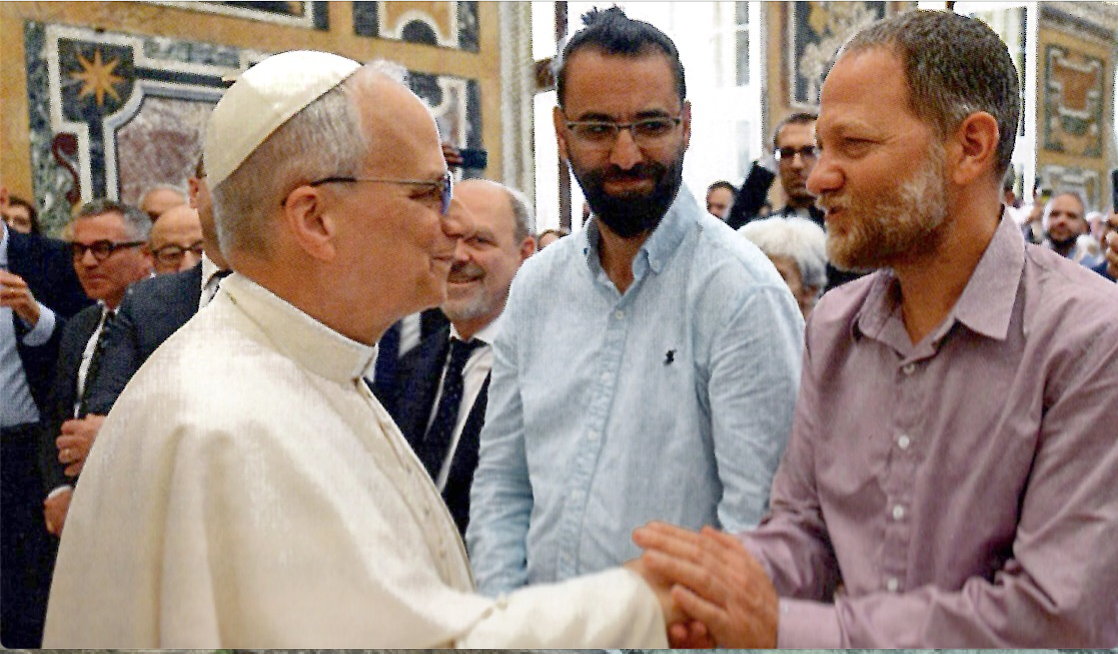
October is also the birth month of my father. That’s my Dad, Bernard Tuell, standing next to me in this photo. I got my laugh and my hairline from my Dad–but also, my love for the Bible and for the Lord. So–happy, happy birthday, Daddy. God bless you, as God has blessed so many through you.











 As this unit unfolds, the prophet continues to draw distinctions between this promised King and other, previous kings. The humble mount in Zech 9:9 derives from a long tradition of royal processions (Meyers and Meyers 1993, 129): by riding an ass rather than a war horse or chariot, the king showed humility, and declared that he came in peace. But this time, the prophet declares, this will be more than theater! This king truly is humble, and not only comes in peace, but comes to bring peace: a promise our war-torn world desperately needs to hear!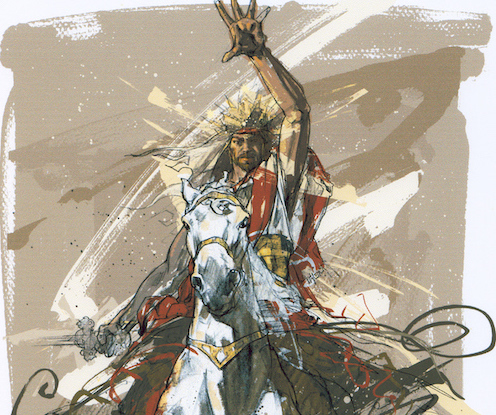



![Title: David and Goliath [Click for larger image view]](https://diglib.library.vanderbilt.edu/cdri/jpeg/Swanson-David-and-Goliath.jpg) I was recently reminded of Christian novelist and essayist Frederick Buechner’s whimsical take on Goliath, from his book
I was recently reminded of Christian novelist and essayist Frederick Buechner’s whimsical take on Goliath, from his book 
![Title: Tapestry of David slaying Goliath [Click for larger image view]](https://diglib.library.vanderbilt.edu/cdri/jpeg/nat-cathedral-goliath.jpg)