The best way to drive out the devil, if he will not yield to texts of Scripture, is to jeer and flout him, for he cannot bear scorn.
This saying of Christian Reformer Martin Luther was used as the epigraph to C. S. Lewis’ famous Christian satire The Screwtape Letters: Letters From a Senior to a Junior Devil–letters of advice from the demon Screwtape to his nephew Wormwood, on how Wormwood could tempt his “patient” into hell: an appropriately “Halloweeny” read, to be sure!
The Screwtape Letters was published in book form in 1943, but began as a wartime serial in The Guardian between May and November of 1941–just after the Blitz, a terrible period during which England was under almost continual attack from Nazi Germany. Indeed (spoiler alert!), Wormwood’s attempts to seduce his “patient” away from his faith fail decidedly when the man is killed by a German bomb, and taken into heaven:
One moment it seemed to be all our world; the scream of bombs, the fall of houses, the stink and taste of high explosive on the lips and in the lungs, the feet burning with weariness, the heart cold with horrors, the brain reeling, the legs aching; next moment all this was gone, gone like a bad dream. . . Did you mark how naturally–as if he’d been born for it–the earth-born vermin entered the new life? (The Screwtape Letters, letter 31).
I commend this book wholeheartedly, friends. It is full of wisdom, and wit. For example, Screwtape advises Wormwood to prevent his patient from attending worship by disillusioning him:
One of our great allies at present is the Church itself. Do not misunderstand me. I do not mean the Church as we see her spread out through all time and space and rooted in eternity, terrible as an army with banners. That, I confess, is a spectacle which makes our boldest tempters uneasy. But fortunately it is quite invisible to these humans. . . . When he gets to his pew and looks around him he sees just that selection of his neighbors whom he has hitherto avoided. You want to lean pretty heavily on those neighbors. Make his mind flit to and fro between an expression like “the body of Christ” and the actual faces in the next pew. It matters very little, of course, what kind of people that next pew really contains. You may know one of them to be a great warrior on the Enemy’s side. No matter. Your patient, thanks to Our Father below, is a fool. Provided that any of those neighbors sing out of tune, or have boots that squeak, or double chins, or odd clothes, the patient will quite easily believe that their religion must therefore be somehow ridiculous (The Screwtape Letters, letter 2).
The Screwtape Letters is dedicated to J. R. R. Tolkien, the Roman Catholic friend who led Lewis into the Christian faith. That connection is particularly interesting, as some of the same Christians who condemn Hallowe’en as a pagan holiday also mistrust the fantasies of both Lewis and Tolkien, fearful of their alleged “occult” influences–despite the explicitly Christian worldview evident in both the Chronicles of Narnia and The Lord of the Rings.
Those well-meaning Christians are of course correct about Hallowe’en’s pagan origins. The night before November 1 was once called Samhain, an old Celtic festival of the quarter-year (falling between the autumnal equinox and the winter solstice). In Celtic culture, it was believed to be a night when the borders between this world and the next became particularly thin, so that the unquiet dead could cross over into this world and molest the living. Food offerings, lamps, and even the severed heads of enemies (grimly recalled, perhaps, by Jack o’lanterns) could be set out to appease or turn aside the ghosts.
We call October 31 not Samhain, but Hallowe’en (that is, “Hallow Even”), because October 31 is of course the night before November 1, All-Hallows Day–hence, All-Hallows Eve. All-Hallows, or All-Saints, Day began in the days of Pope Boniface IV as a feast day for all martyrs, and was first celebrated on May 13, 609. Pope Gregory III (731-741) shifted the focus from the martyrs to the celebration of all the saints who lack a feast of their own (and by extension, of all who have died in the Lord), and as such All-Saints was declared an official holy day of the church by Pope Gregory IV in 837. The feast was shifted from May to November 1 in response to the European (specifically Celtic) holiday of Samhain.
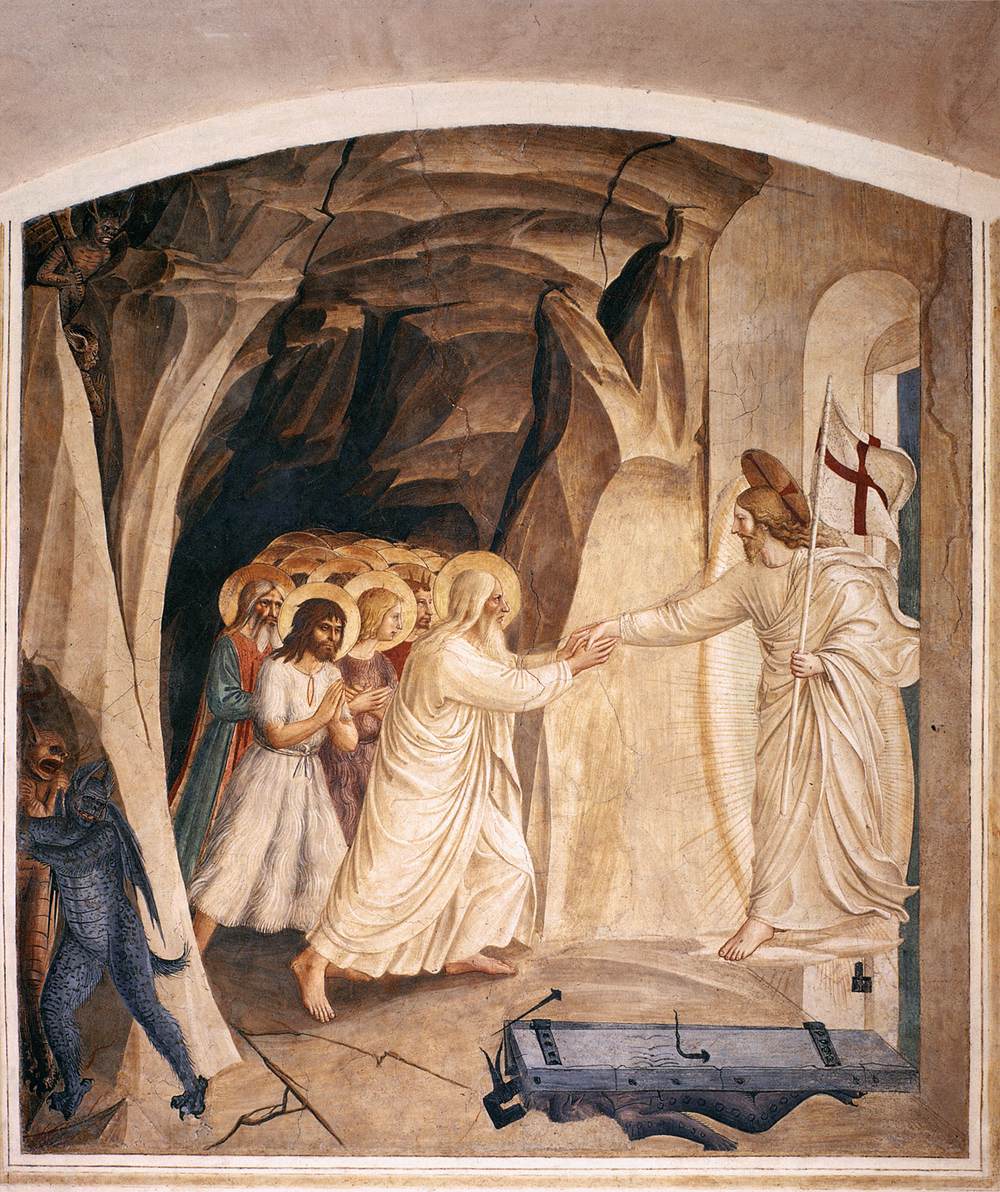
When the Celts became Christians, this night was transformed by the realization that Jesus Christ had triumphed over death, hell, and the grave. Death, and the dead, no longer needed to be feared. Those Celtic Christians now knew, as Ephesians 2:4-7 affirms,
God is rich in mercy. He brought us to life with Christ while we were dead as a result of those things that we did wrong. He did this because of the great love that he has for us. You are saved by God’s grace! And God raised us up and seated us in the heavens with Christ Jesus. God did this to show future generations the greatness of his grace by the goodness that God has shown us in Christ Jesus.
The association with All-Hallows Day made this a night of rejoicing! Hallowe’en, friends, is a celebration of life, and of Christ’s victory over death and the fear of death. I think it is fitting that this night, which used to be a grim and grisly night of fear, has become a night of laughter and joy, when it is little children who come to our doors to receive our offerings of food. Surely, as Luther and Lewis alike understood, there is no better medicine against fear and despair than joy and laughter!

These waning days of October prompt anticipation, not only of Hallowe’en, but also of Election Day on November 4. In addition, October 18 saw “No Kings” rallies, held across the country, draw nearly seven million people (this picture is from Pittsburgh). In response to Hallowe’en, the forthcoming election, and to these protests of injustice and inequality, the following item, allegedly from The Screwtape Letters, is once more making the rounds on social media:
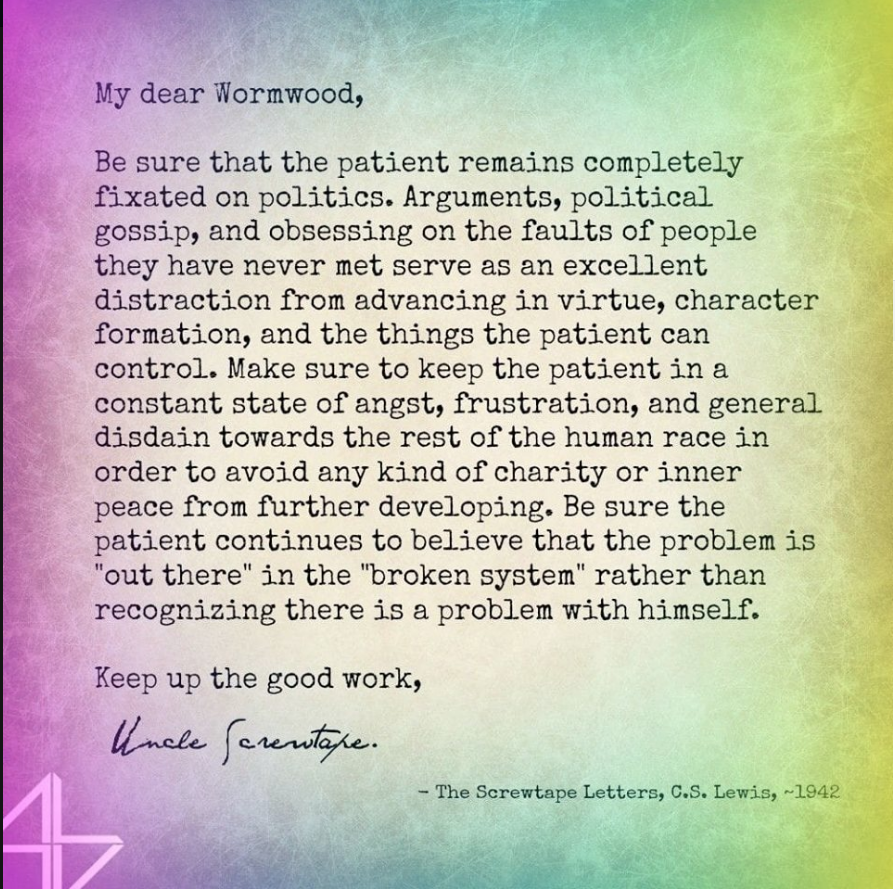
The claim is clear: caring about politics, trying to fix a “broken system,” and particularly participating in protests like No Kings are demonic distractions from Christian faith and spiritual growth. However, this is NOT a quote from The Screwtape Letters, or indeed from anything else by C. S. Lewis. Further, it makes claims with which Lewis himself would have surely disagreed.
To be sure, in The Screwtape Letters, Screwtape does advise Wormwood to get his client thinking obsessively about politics–whether conservative or liberal (“Patriotism or Pacifism”, in Lewis’ World War II English context) doesn’t matter:
Let him begin by treating Patriotism or Pacifism as a part of his religion. Then let him, under the influence of partisan spirit, come to regard it as the most important part, Then quietly and gradually nurse him on to the stage at which religion becomes merely part of the “cause” (The Screwtape Letters, letter 7).
However, this does not mean that Lewis believed we should be concerned simply for the salvation of our own souls. First, while Lewis would certainly agree that sin and salvation are personal, he would certainly not agree that either sin or salvation is private. Second, Lewis would certainly not agree either that concern for a “broken system” is misplaced, or that trying to fix what is wrong in our world is futile.
Remember that The Screwtape Letters was born in the Nazi Blitz! Lewis was well aware of the dangers posed by systemic, political evil, and of the responsibility owed by citizens to work for the common good. Our Christian faith does not call us to quietism–indeed, loving what God loves will engage us positively and passionately with what God is doing in the world.
If you believe that your involvement cannot make a difference in the world, please don’t think to justify your passivity and cynicism by appeal to Lewis–though, come to think of it, Screwtape and his ilk likely are involved. And should we despair in the face of the powers that be, our Christian faith also reminds us that we, together with all the saints who have gone before us, are part of something larger than politics: the Church of Jesus Christ, “spread out through all time and space and rooted in eternity, terrible as an army with banners.”

AFTERWORD: October 31 is also my Dad’s 91st birthday, and October 3rd was my 69th. So, happy birthday to US!