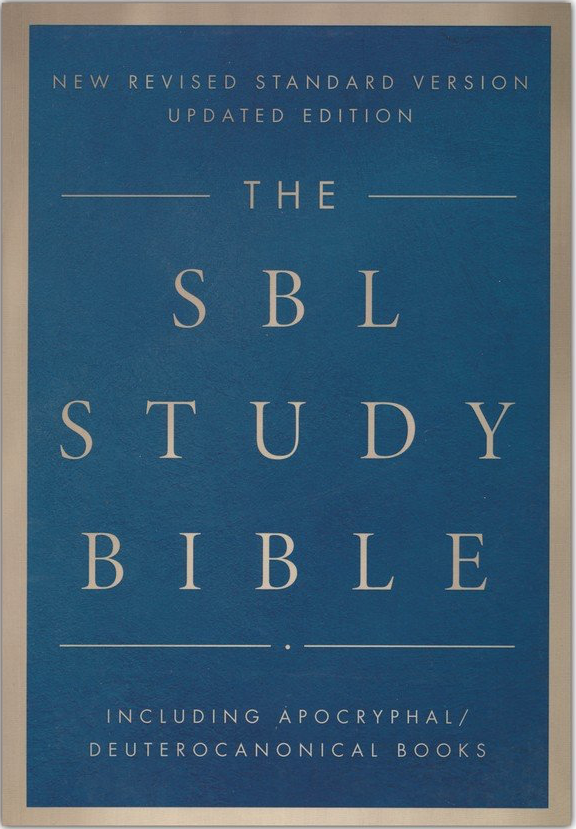
I have already written about the still relatively new NRSVue: the updated edition of the New Revised Standard Version. I have commented at some length on those places where I find this Bible useful, even beautiful, and on those places where I disagree with the text-critical choices its editors have made.
However, I have only recently come to appreciate two passages in particular where the NRSVue distinguishes itself, not for some fresh insight or new discovery, but rather for its willingness to acknowledge our ignorance: places where we do not know for sure what the text means. Those passages are 1 Corinthians 6:9-10 and 1 Timothy 1:9-10: two texts often cited concerning same-sex relations.
Both passages are “vice lists:” stereotyped lists of offenses, often used by moral teachers in the Greco-Roman world. These lists are common in Pauline literature (that is, the New Testament letters associated with the Apostle Paul), and their contents vary (for example, see Rom 1: 29-31; 2 Cor 12:20; Gal 5:19-21). They are never unpacked in context: that is, the individual elements in the list are not discussed in any detail, and no case is made for naming any part of the list as a vice. The entire list is thrown out as a block, to establish a consensus the teacher can then build upon: these are actions that the author assumes the entire community will regard as unacceptable. Among those condemned, 1 Corinthians 6:9 lists malakoi. Both 1 Corinthians 6:9 and 1 Timothy 1:10 also mention arsenokoitai.
Both words are uncommon. In the Bible, the Greek word malakos (“soft”) occurs only twice in the Septuagint, the Greek translation of Jewish Scripture: Proverbs 25:15, for the Hebrew rakah (CEB has “tender”), and Proverbs 26:2, for the Hebrew mithlakhamim (“delicacies;” CEB has “choice snacks”). Apart from 1 Corinthians 6:9, malakos appears only two other times in the New Testament: in Matthew 11:8//Luke 7:25, for the “soft robes” (CEB has “refined clothes”) worn by the rich. As for arsenokoitai, this word occurs only in these two passages in our Bible, and is found nowhere else until after its use in the New Testament by Paul. None of this helps us understand what these words, or these passages, mean in context.
However, that has not prevented Bible translators from making rather bold claims. The old NRSV and the 1984 NIV alike render malakoi as “male prostitutes,” while the KJV has “effeminate.” For the term arsenokoitai, NRSV had “sodomites” in both places; the 1984 NIV has “homosexual offenders” in 1 Corinthians and “perverts” in 1 Timothy. The KJV reads “abusers of themselves with mankind” in 1 Corinthians, and “them that defile themselves with mankind” in 1 Timothy.
The CEB has “both participants in same-sex intercourse” in 1 Corinthians 6:9; a footnote confidently explains that this refers to “submissive [that is, malakoi] and dominant [that is, arsenokoitai] male sexual partners.” Similarly, the new NIV reads “men who have sex with men;” the translators’ footnote says that these words “translate two Greek words that refer to the passive and active participants in homosexual acts.” In 1 Timothy 1:10, the CEB renders arsenokoitais as “people who have intercourse with the same sex,” while the most recent edition of the NIV has “those practicing homosexuality”–translations difficult to understand, since the word must refer to something that men (Greek arsenos) do, and not to same-sex relations generally (as is also the case in Lev 18:22 and 20:13; biblically, only Rom 1:27 specifically mentions lesbians).

Turning to Greek literature roughly contemporaneous with our New Testament, we find the term malakos in a history of the Roman Empire by Dionysus of Halicarnasus (ca. 60-7 BCE):
The tyrant of Cumae at that time was Aristodemus, the son of Aristocrates, a man of no obscure birth, who was called by the citizens Malacus or “Effeminate” — a nickname which in time came to be better known than his own name — either because when a boy he was effeminate and allowed himself to be treated as a woman, as some relate, or because he was of a mild nature and slow to anger, as others state (Roman Antiquities 7.2.4).
Since Dionysus admits that he is not sure why Aristodemus was nicknamed “Malacus” (“Softie”), this reference is not decisive–though the rumor that Malacus was “treated as a woman” when he was a boy suggests that perhaps malakos had to do with the sexual abuse of boys.

In his discussion of Lev 18 (see Special Laws 3.5–8), the Jewish philosopher Philo of Alexandria (20 B.C.-50 C.E.) uses the term malakia (clearly related to malakos) with reference to pederasty–sex with boys:
And let the man who is devoted to the love of boys [Greek paiderastes] submit to the same punishment, since he pursues that pleasure which is contrary to nature, and since, as far as depends upon him, he would make the cities desolate, and void, and empty of all inhabitants, wasting his power of propagating his species, and moreover, being a guide and teacher of those greatest of all evils, unmanliness and effeminate lust [Greek malakias], stripping young men of the flower of their beauty, and wasting their prime of life in effeminacy (Special Laws 3.7.39).

Robert Gagnon suggests that Paul himself may have coined the word arsenokoitai, with reference to Leviticus 18:22 in the Septuagint–where the Greek words arsenos (“male”) and koite (“bed,” specifically “marriage bed,” hence our word “coitus”) both appear (Robert A. J. Gagnon, The Bible and Homosexual Practice: Texts and Hermeneutics [Nashville: Abingdon, 2001], 312). If this is so, then Paul may be creating a term here to use for male homosexuality. In Talmud, however, as in Philo, the infamous Leviticus 18 and 20 passages are read specifically with reference to pederasty (see b. Sanhedrin 54a-55a).
In Greco-Roman society, it was not at all uncommon for an upper-class man to take a boy as his ward, teaching him, enculturating him, introducing him into society–and using him sexually. The myth of Jupiter and Ganymede, depicted in the plaque above, gave religious sanction to these relationships. Still, as J. Paul Sampley observes, Roman moral philosophers such as Seneca, Plutarch, and Dio Chrysostom objected to the sexual exploitation of boys (and sometimes girls) enslaved in households for same-sex relations (J. Paul Sampley, “1 Corinthians,” in The New Interpreter’s Bible, Vol 10, ed. Leander Keck [Nashville: Abingdon, 2002], 859). Perhaps this is what Paul too had in mind in 1 Cor 6:9 when he placed malakoi and arsenokoitai in his vice list, and the Pastor when he placed arsenokoitai in his (1 Tim 1:10).
This does not mean that either Paul or his Jewish contemporaries approved of homosexual behavior; certainly they did not (as Philo’s argument above demonstrates, and as Rom 1:24-27 shows with regard to Paul). But it does mean that the New Testament vice lists, often used to condemn all same-sex relationships as immoral, are at best ambiguous. Indeed if, as seems likely, 1 Corinthians 6:9-10 and 1 Timothy 1:9-10 in fact condemn child abuse, then these vice lists have nothing to say about committed, loving relationships between consenting LGBTQ+ adults.
In any case, too many translations of Scripture pretend to a confidence in the meaning of malakoi and arsenokoitai that we actually do not, and cannot, have. By contrast, while the NRSVue follows the NRSV in rendering malakoi as “male prostitutes,” a textual footnote on the word notes, “Meaning of Gk uncertain.” Unlike the NRSV, the NRSVue renders arsenokoitai in both passages with appropriate ambiguity, as “men who engage in illicit sex,” and textual footnotes on the word read, again, “Meaning of Gk uncertain.”
As the NRSVue refreshingly acknowledges, we do not know for certain what malakoi and arsenokoitai mean–and when we do not know what a word means, we ought to in all honestly admit our ignorance. Like the Sodom story, the story of the Levite’s concubine, or the Old Testament temple prostitution texts, these passages have no relevance to our contemporary conversation about sex and gender.